Thursday, March 3, 2011

Blog #5 There have been 5 major extinction events throughout history, are humans impacting the 6th? Why or why not?

There have been 5 major extinction events throughout history, are humans impacting the 6th? Why or why not?

Since there are already 5 major extinctions throughout history, humans are going to have an impact to the 6th because humans are ruling this world currently, not animals, not mystical creatures, but humans. Humans together gather ideas of what to do in the future or right now, such as doing the captive breeding program-keeping animals from wildlife so they don't become extinct, but also keeping them in "jail." In addition, humans use electricity a lot; therefore, affecting the earth/environment in many ways. It is also why people are spreading the words to: Go Green and also reuse, recycle, and reduce. Apply it to yourself too! We can also see the world is changing because of the weather. For instance, during christmas time it was pretty hot and I thought winter was suppose to be cold. 

However, some incidents don't happen because of humans, but because of world changes. For example, we can't control when earthquakes stop, when hurricanes come, when a meteor crashes to earth or even when lava erupts; we have to face it and unfortunately, some animals or species may extinct by this. Because of mother nature, we simply cannot stop a meteor with our own hands like we can when there is a can being thrown at you. 

Thursday, February 24, 2011

Blog # 4 Describe the three types of selection: directional, stabilizing and disruptive and give an example of each in your own words

Describe the three types of selection: directional, stabilizing and disruptive and give an example of each in your own words.


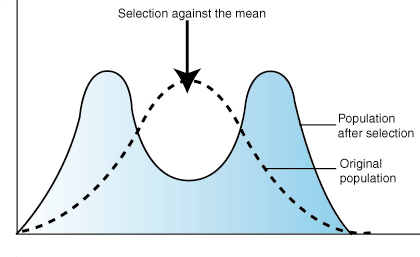
Natural selection can affect the distributions of phenotypes in any of three ways which are directional, stabilizing, and disruptive selection.
Directional selection helps those individual species that have extreme variations in traits within a population.
Stabilizing Selection are the average traits in a population.
Last of all, disruptive selection is similar to directional selection which helps the extremes traits in a population.


Stabilizing selection happens when individuals at one end of the curve have higher fitness than individuals in the middle or at the other end. For example, teenagers are the time of each life, most likely. Because teenagers are healthy, both emotional and physically for most of us, we can do so much that maybe adults and little kids cannot do.
Therefore, most of us can eat whatever we want, learn a lot of different stuff from our public schools, we have so much privileges that some adults and kids don't have yet or have received already; we still have our upside-downs for teenages; for instance, when we cannot go to a horror movie because we are not old enough, or cannot drink red wine because we are still too young too, not that I want to presently. Kids can't just stay home alone without a parent because it is too dangerous, and their brains aren't fully developed whereas there are not much stuff/incidents for them to worry/think about. For adults, they have so much responsibilities because adults have to pay for their gas bills, take care of their children (if they have any), or even work hard on their jobs instead of slacking have which children can do right now in school if they choose to because their futures are not set yet. The middle is just right at the time of life.

Distriputive selection happens when individuals at the upper or lower ends of the curve have higher fitness than individuals near the middle, disruptive selection takes place which states the beginning or the ending is better than the middle. For example, you want to buy a pair of shoes but the worst part of buying those shoes you want is the middle because that is the part when you have to pay. In the beginning when you saw those pair of shoes, you just try it on and you look in the mirror and yourself if it looks pretty or feels comfortable for your feet. In the end, you buy the shoes and you can wear them right away and buying the shoes and having it in your hand are the results, which is one of the best times when purchasing a pair of shoes.


Directional selection is a little different because it takes place when individuals near the center of a curve have higher fitness than individuals at either end. This can mean it's better to wear tennis shoes better than wearing flip flops when you are racing for the track team sport. Even though this example seems really obvious, it is a simple, yet good exampple for directional selection. This example demonstrates how wearing the best shoes improve on your running and also standing. Wearing tennis shoes instead of flip flop shoes can make your feet feel more comfortable inside and it won't get your foot injured as easily when you probaly stepped on a nail on the floor. Wearing flips flops may cause injuries like slipping easily or having an impact that may cause your feet to hurt if your sprint. It can also bring you to the first place trophy if you wear good shoes!

Friday, February 18, 2011

Blog #3 Explain what microevolution is? What are the three ways that variation occurs?


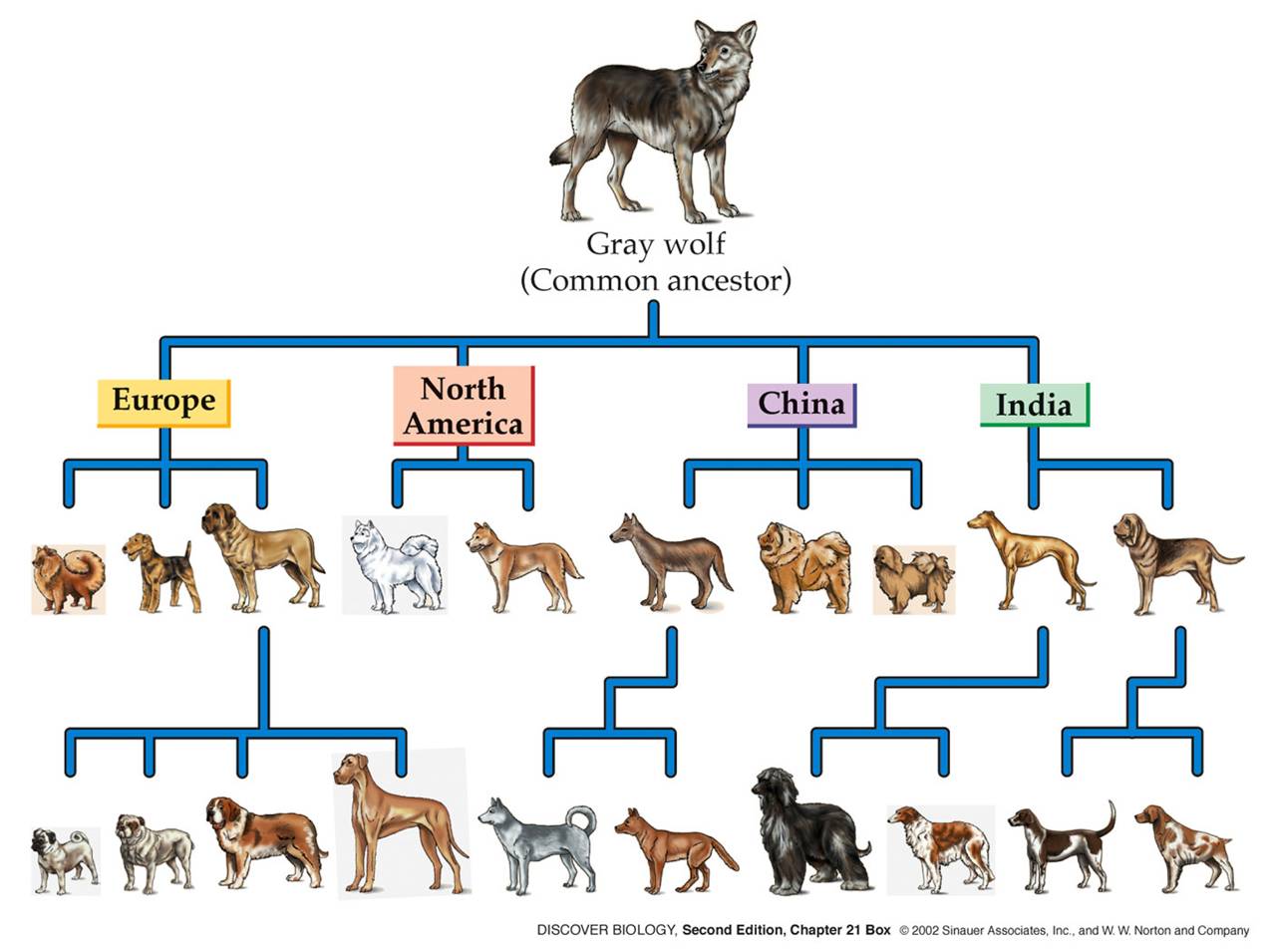
Microevoultion is a change in gene frequency within a population. It can also be defined as evolution on a small scale within a single population meaning to narrow our focus down to one branch of the tree of life. However, microevolution means that if an animal or plant produce with another different  species, it produes a new bizzare species. For example, if dogs--like poodle and golden retriever are together and have a dog, the dog will be a mix of both when give birth. Maybe perhaps thousands of years later, dogs and cats will start being together and having their own babies; therefore, making their own animal that was probaly never existed in Earth.


The three ways of how variation occurs of microevolution is mutation, genetic drift, and natural selection. All three of these affect the gene frequencies in a population; mutation can randomly mutate one gene to another. Genetic Drift affects the genetic makeup of the population but it is different from natural selection whereas through an entirely random proess. Genetic Drift doesn't work to produce adaptions even though it is a mechanism of evoultion. For instance, beetles can produce differently when it comes to a different or next generation.  The last way, natural selection is the process by which traits beome more or less common in a population due to consistent effects upon the survival or reproduction of their bearers. (natural selection from wikipedia; internet)

Thursday, February 17, 2011

Blog #2 Why is the fossil record hard to interpret?

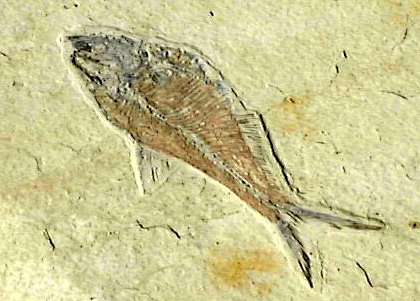
The fossil record is hard to interpret because there are many different types of fossils and many of the fossils come from different time. However, it is also hard to interpret because of the similarity of the fossils.
 For example, two different sea animals--dolphins and sharks may look a little alike like the shape of it because they are both pretty large and blue; therefore, they are really different. The shark's skeleton is made of cartilage whereas the dolphins' skeleton is made of bone and there are also other different kinds of stuff that one does and the other doesn't do underneath their skins. 


Another reason is because when you see a print that can look like an animal but it isn't....like when a corn has an imprint on it but it isn't considered a fossil because a corn was never alive, so it cannot be dead. 
The fossil record is also hard to define is because it is not complete. Some dates/ages/time period are missing that time of a fossil; there is like a gap at a time period like there was no animal found at that time. Some fossils may still be out in this world, it is really rare and a fossil from the past are too ancient yet there are a lot in the fossil or archeologists.

Thursday, February 3, 2011

Semester 2-Blog #1-Why is evolution a theory and not a law?

Why is evolution a theory and not a law?
To begin with, what are the definitions of evolution, theory, and law?
Well, evolution, or change over time, is the process by which modern organisms change over time.
However, a scientific theory is a well-supported testable explanation of phenomena that have occured in the natural world. Additionally, evolutionary theory is a collection of scientific facts,observations, and hypotheses.
Lastly, law is a scientific generaliztion based on experimental observations of physical behavior.

As stated, (evolution) organisms can change overtime; therefore, a theory can only be proven/supported when things has happened in the natural world. For example, Darwin had made numerous observations and gathered evidence that later led him to propose revolutionary hypothesis about the way life changes over time. Evolution is based on the changes of time which is also what a theory is based on to be proven correct.
A law has no contribution with evoultion whatsoever...it even states it in the biology book-the chapter of evoultion. 

Thursday, January 13, 2011

Blog #14

What was you favorite activity/topic this year? Why was it a favorite?
What was your least favorite? Why?
If you could change one thing (Not the amount of homework) what would it be and how would you change it?


My favorite activity or topic this year was microscopes because I learned how things look such as bacteria or the stuff growing in an onion or my saliva. It was really interesting how we got to know how to use a microscope because I felt a professional scientist when I was looking at the microscope inside.
Especially the time when we say the pond water moving a little, it was actually the bacteria inside because the pool water was way to dirty so looking at in the microscope was actually a good way to know never to fall inside the pond in whenever you see mainly in the park where the ducks and frogs live in.


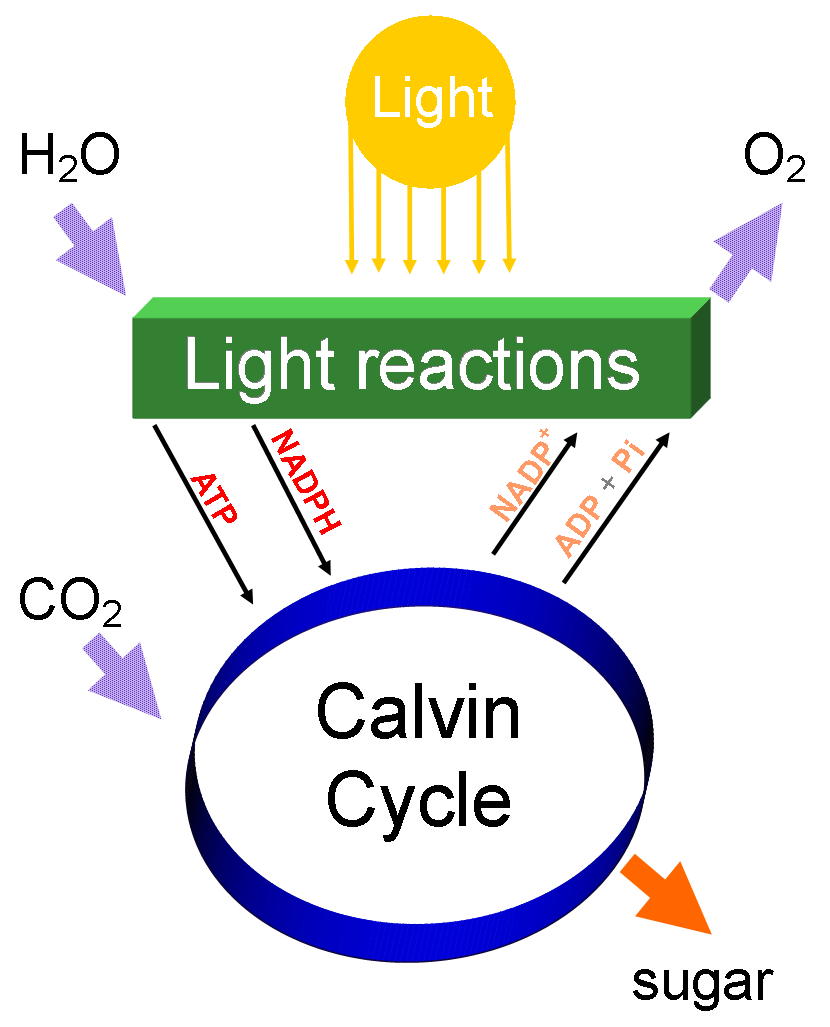
My least favorite topic is the meiosis, mitosis, The Kreb's Cycle, and even the Calvin Cycle mainly because there are so much procedures you need to remember and it is hard for me to remember so much when it is about the same thing over and over. All the procedure of the different cycles all confuse me because they are similar. For example, meiosis and mitosis is a little bit similar and so is the word!! It is also hard for me to understand sometimes but not the part when the chromosomes split or anything, yet the process confuses me sometimes. It also confuses me with the words such as NADPH, ADP, ATP and etc.


If I could change one thing in biology class, I would read more and try to understand more about the cycles and the topics that have procedures in it. I would make index cards to keep me understanding better about the process and what they are for. For example, mitosis happens in people's bodies but to me, I think I just have to learn the basics. Basics can describe other stuff like I need to change my toothpaste every six months to keep the bacteria away.

Monday, January 10, 2011

Blog #13 DNA

Blog #13 How has DNA changed how we investigate crimes? What are the two main tests? Describe them

First of all, DNA changed how we investigate crimes drastically compared from before like the 1700s. DNA testing can help women to investigate who raped them by doing a DNA testing if they aren't too embarassed too go get checked. However, DNA testing can help other crimes than rape. For example, it can also help the people who got robbed in their house by seeing if the robber might have left their DNA: their hair, skin cells, saliva, etc. in the house somewhere. DNA has lots of use at a day like this. It can also see if any student touched their teacher's desk so stay away from their stuff when you are suppose to because the teacher can do a DNA testing on her table when she wants to...! Scary, isn't it? DNA helped solve lots of crimes in these modern day; it also helps some other stuff like helping children finding their parents or seeing if that is their biological parent. Therefore, it can also help people see if a person's blood type matches with someone elses to save their life. DNA saves lives, maybe even me someday!!! DNA testing cannot be 100% true, but it can be 99.9% true.
The two main tests of DNA are PCR and RFLP. PCR stands for polymerase whereas RFLP stands for restriction fragment length polymorphism. PCR is a naturally occuring enzyme, a biological macromolecule that catalyzes the formation and repair of DNA. This PCR, differs in reliability and effectiveness and this DNA testing allows you to make multiple copies of a DNA sequence in a short period of time. It's what used for electrophoresis for finger printing and etc. RFLP is another main DNA testing, it provides important information such as screening human DNA for the presence of potentially deleterious genes or providing proof to show the innocenece of one person's crime.